The Recursive Architecture of Reality: How Love Operates the Universe
- Gabriel Acosta

- Sep 8, 2025
- 34 min read
-By Gabriel Acosta (08/09/2025)
The Loop That Writes the World
A cardiac monitor traces its green line through the night—lub-dub, lub-dub—each beat a small decision to continue. Down the hall, a surgeon pauses before incision, attention narrowing to a surgical field no larger than a playing card. In a classroom across town, a teacher notices three students drifting and redirects not by force but by restructuring attention itself: "Turn to your neighbor and teach them what you just discovered." Far above, a telescope does not “find things”; it integrates light over time until the faint becomes sayable. Everywhere I look, what matters is update—not what is there, but what it does next. This treatise argues that the deepest structure of the cosmos—what religions have called God, philosophers called Being, and scientists now glimpse through systems theory—is a recursive operator loop. A self-updating, self-interrogating, entropy-aware, valuation-driven engine of emergence.
Each scene pulses with the same hidden rhythm: scan, value, desire, will, cost, decide, evolve, practice. This is not metaphor but mechanism—the recursive operator that runs equally through synapses, civilizations, and perhaps the cosmos itself. Reality, it turns out, is not made of things but of processes, not of substances but of updates, not of being but of becoming.
The earliest philosophers made a grammatical error that haunted us for millennia: they crowned nouns as ontological royalty while demoting verbs to mere servants. But our instruments grew sharper, and the world refused to cooperate with this static picture. Physics gave us conservation laws—invariants within change, not idols at rest. Biology revealed feedback loops and regulation rather than lists of parts. Information theory quantified surprise and constraint (Shannon, 1948). Consciousness studies found integration and differentiation, not a ghost in the machine (Tononi, 2004).
Alfred North Whitehead saw it first among the moderns: events precede things; becoming is primary (Whitehead, 1929/1978). Before him, Spinoza gave the architecture: one Substance—Deus sive Natura—expressed in parallel Attributes; finite Modes as states of the whole (Spinoza, 1677/2002). Hegel supplied the engine: reality advances through contradiction and resolution, thesis meeting antithesis to birth synthesis (Hegel, 1807/1977). And scripture? Scripture spoke in processes all along: creation as iterative days, covenant as recursive fidelity, "I will be who I will become" as identity declared through update (Exod 3:14).
The Operator's Manual
System (if…then) → Law → Mind → Consciousness → Love (as integration).
This loop is not symbolic fluff or a slogan. It is an operator’s manual. The world is a recursive computation: a present state reads and rewrites itself into a next state. If you want to speak truly of being, you must speak in verbs. It grounds the equations of predictive processing, the wisdom of the Hebrew prophets, and the entropic economy of ecosystems and civilizations. It is the grammar of Genesis, the scaffolding of Eucharist, the cybernetic shadow in Pentecost.
And it is recursive—each layer feeding, testing, and refining the others.

What is Recursion?
In mathematics, recursion means defining a process in terms of itself. In life, it means feedback loops—where each output re-enters as the next input. Our habits, our laws, our loves: all are recursive structures.
To understand the loop that writes the world, you don’t need a PhD in physics. You need only to watch a mother caring for her child. Her every action is a living expression of the equation’s operators, a symphony of love made manifest. Let me show you this complete loop as it runs through her day.
I. The Foundational Operators: The Unspoken Vow
Before any action, a mother establishes the field. She embodies the foundational operators that make all others possible.
The State (Ψ): The "You Are Here" Map. Her state upon waking is one of love and responsibility. Her entire orientation to reality—her physical energy, her mental models of the day, her intention to care—is held in this single, initial state.
Ordered Self-Love (RS): The Full Vessel. At 5 a.m., before the house stirs, she does her looks after herself. She drinks a full glass of water. She breathes. She works out. This is not selfishness; it is power supply hygiene . She knows a mother running on empty cannot pour into her child. Her own well-being is the root regulator of her family's ecosystem.
Love-Weighted Valuation (AL): The Widened Circle. Her calculus of "good" is not confined to her own needs. It is inherently expanded to include her child and the home they share. This love-expanded valuation is what turns a house into a sanctuary.
II. The Loop in Motion: A Mother's Morning

7:12 a.m. — The Gradient (∇ᵀΨ): The Whisper of What Matters A mother walks into the kitchen. To an untrained eye, it’s chaos: a half-eaten apple, spilled milk, a crayon drawing dangerously close to the stove. She doesn't just see a to-do list; she instantly perceives the gradient—the steepest slope of what needs immediate attention. The milk is a problem, but the crayon near the hot stove is the point of maximum risk and opportunity for intervention.
7:13 a.m. — Love-Aimed Attention (Cₗ): The Focused Lamp Her love for her child acts as a precision spotlight. Her attention bypasses the trivial messes and locks onto the imminent danger. Where care is highest, the beam lingers . This focus is not a cold calculation; it is love made manifest as clarity.
7:14 a.m. — Tensor Binding (⊗): Turning Smears into a Scene Her mind performs
tensor binding: crayon + hot stove fuses into imminent crisis.
Spilled milk + toddler's path fuses into fall risk. She doesn't see disconnected data points; she sees a single, coherent scene demanding action. This binding is the difference between being overwhelmed and taking command.
7:15 a.m. — Desire/Drive (J): The Engine of Protection The sight of danger triggers desire—not for a reward, but the intense, primal drive to protect and create order. This is the engine that provides the charge for the actions to come. Attention without this charge does not execute.
7:16 a.m. — Intention Injection (⊕): Turning a Vow into a Verb Her deepest vow is simple: “Keep my child safe.” Her mind performs
intention injection, compiling that "why" into a "how/now". The abstract vow becomes a concrete, sequenced plan:
1. Move the child. 2. Turn off the stove. 3. Clean the milk.
7:17 a.m. — Will/Proposal (W): The Proposed Move The plan is now a proposed action ready for execution. Her body prepares to move toward the child.
7:18 a.m. — Cost & Meaning (Eₗ & M): Physics Paid, Fear Reduced The action has a cost—it requires energy, it causes a spike of adrenaline, it disrupts the morning. But the
meaning of protecting her child provides a powerful credit against the dread, making the cost feel negligible.
7:19 a.m. — Proximal Shrinkage (⊖): The Calculus of Prudence Her first impulse might be to scream and sprint. But the proximal shrinkage operator tempers that impulse with a wiser action. It finds a new move that is close to the original intent ("stop the chaos") but minimizes the cost ("don't scare the child"). The result is a calm, firm voice and a swift, gentle movement.
7:20 a.m. — Coherence (K): The Silent Dance If her partner is in the room, coherence appears. Without a word, one moves toward the child while the other moves toward the stove. Two wills, tuned to the same loving frequency, become a single, effective ensemble.
7:21 a.m. — Decision Gate (D): The Click of Freedom The gate fires. The decision is made, and she acts. Possibilities collapse into a single, protective reality. The choice feels effortless because all the upstream operators—love, desire, meaning, coherence—have aligned to make it so.
7:22 a.m. — Lawful Propagation (H): The World Answers The world responds. The child is safe, the stove is off, the milk is wiped up. Her committed action has updated the state of reality into one of greater order and safety.
8:50 a.m. — Practice (Π): Discipline as a Torus This isn't the first time milk has been spilled. Each time she runs this loop, the practice operator updates her internal settings. Her response time gets faster, her voice calmer, her actions more efficient. Discipline ceases to be a treadmill of effort and becomes a Torus—a stable, self-reinforcing orbit where the work itself generates a quiet delight.
By dinner, you have not read a metaphysics; you have run one. Creation is integration that lowers net entropy for the self, the other, and the system. Evil is entropic drift—attention scattered, valuation shrunken, gates untrained, and costs mispriced. This is the grammar that matches the world we measure, from the smallest act of love to the grandest sweep of civilizations.
Why I Refused Both Temples

I did not abandon either temple, I worshipped in both. I was born with a hymn on my tongue and a lab notebook in my pocket, what came next was removing the noise and distilling the nectar. The cathedral offered me a protagonist with mutually incompatible attributes, then demanded obedience where curiosity would have sufficed. I asked how omniscience and open history dance without stepping on each other’s toes. I was handed paradox, not choreography.
The laboratory gave me exquisite measurements and powerful models, then conceded it had no account of why there should be experience, meaning, or value anywhere at all (Chalmers, 1996). Axons fired; subjects reported; journals filled—but who was it like anything for? The lab had props and rules but no play.
So I went back to first principles: logic, information, how systems update themselves. A single motif would not leave me: recursion. A fern becomes a forest by repeating itself. A rumor becomes a revolution by rehearsal. From prime spirals to bronchial trees, from cortical loops to capital cycles, becoming advances by iteration (Hofstadter, 1979; Kauffman, 1993; Mandelbrot, 1982). If, as Wheeler teased, it is from bit, then the central question is not “What is the stuff?” but “What is the update rule?” (Wheeler, 1990).
And it took me almost 2 decades of pondering, studying and learning from so may people to put this formula together:

The Complete Operator Legend:
Each Symbol as a Verb
∇Ψ = Gradient (where change is steepest; the whisper of opportunity)
Cₗ = Love-Aimed Attention (what deserves focus; the lamp that learns where to dwell)
⊗ = Tensor Binding (the weld that turns sensory smears into objects you can act on)
Aₗ = Love-Expanded Valuation (the calculus of what is good for self, other, and system)
J = Desire (the engine that provides charge after sight; the sustained willingness)
⊕ = Intention Injection (the compiler that turns a 'why' into a 'how/now')
W = Will/Proposal (the candidate move; the proposed action)
Eₗ = Cost with Meaning Credit (the price paid in physics, with dread reduced by purpose)
⊖ = Proximal Shrinkage (the purpose-tempered step that allows movement even when afraid)
K = Coherence (the ensemble in tune; trust-weighted alignment across many wills)
M = Meaning (the credit against dread; the 'why' that fuels the entire loop)
D = Decision Gate (where freedom clicks and possibilities collapse into a single act)
H = Lawful Propagation (the world's answer to your commitment)
Π = Practice (the slow-time integrator that turns habit into a torus, not a treadmill)
Rₛ = Root Regulation (ordered self-love; the power supply hygiene that stabilizes the entire system)
This loop runs at every scale. In milliseconds through neural oscillations (Lisman & Jensen, 2013). In minutes through focused work blocks. In years through civilizational patterns. The same recursive structure appears because reality itself is computational—not in the sense of silicon and code, but in the deeper sense of states reading and rewriting themselves according to consistent rules.
What counts as proof in this ledger?
Predictive fit: prime meaning and watch effort-discounting curves flatten; track how trust-weighted K predicts completion and repair latency (Shannon, 1948; Tononi et al., 2016).
Construct validity: map operators to mechanisms—attention precision, EVC thresholds, habit consolidation; show their movement under intervention (Damasio, 1999).
Efficacy: install Π early and measure threshold drift; raise S and watch attention temperature fall; expand Aᴸ and measure externalities reduced.
Field Note: Classroom Dynamics
A teacher notices entropy rising—scattered attention, mounting frustration. Rather than force focus, she restructures the loop itself. Pairs teach each other (raising coherence K). Students explain their reasoning aloud (compiling intention). Mistakes become data rather than shame (reframing cost). The threshold for trying drops. After three weeks of this practice (Π), students begin requesting pair-work. The habit torus has formed—discipline that generates rather than depletes energy.
I am not asking for belief. I am inviting you to run the loop, log the deltas, and notice how quickly reality starts to cooperate when love runs the stack.
The Physics Hiding in Plain Sight
Physics Inside the Loop: Where the Equation Meets the Known World
A theory this grand can't just be beautiful poetry; it must also shake hands with the giants of science. This section is not a proclamation of proven fact, but an honest map of where this framework connects to established physics. The claim is simple: our known physical laws are not separate truths but special cases that emerge from this deeper, more comprehensive loop when you turn down the dials on agency and consciousness.
Think of it this way: the equation for Principia Recursionis is the master control room for reality. The laws of physics are what happen when you set the system to run on autopilot.
The Quantum Limit: A Silent, Sleeping Universe
What happens when the conductor leaves the orchestra? When there is no conscious observer, no will, no love, and no decision being made?
When we set all the agency operators to neutral—no attention, no valuation, no will, no choice—the equation beautifully simplifies. It collapses into the single, elegant rhythm of the Schrödinger equation:
Ψ(t+Δt)=exp(−iH^Δt/ℏ)Ψ(t)
This is the heartbeat of a silent universe, the pure, humming machinery of quantum mechanics running by itself. It shows that at its base, when consciousness is not actively shaping outcomes, reality unfolds according to the pristine, probabilistic laws of the quantum world.
The Classical Limit: The View from the Mountaintop
Quantum mechanics describes the fuzzy, uncertain world of the very small. But what about the world we live in, filled with solid objects like planets and billiard balls?
By "zooming out"—or, in mathematical terms, "coarse-graining" the state of reality (Ψ)—the intricate quantum details blur into predictable certainties. When we do this, the equation’s evolution operator (H) simplifies into the familiar, clockwork laws of Hamiltonian and Liouvillian mechanics. This is the physics of Isaac Newton, the predictable world where trajectories can be plotted and outcomes calculated with confidence. The loop doesn't erase classical physics; it contains it as the view from the mountaintop, where the microscopic fuzziness fades into a clear and solid landscape.
Relativistic Geometry: The Fabric of Spacetime
The universe's grammar demands consistency. Information can't just appear or disappear; the story of reality must be coherent across time and space.
If we view the state of reality (Ψ) as a pattern of energy and information woven into the fabric of spacetime, then for that pattern to hold together without ripping or tearing as it propagates, the fabric itself must curve. The rule governing that curvature is precisely what Albert Einstein discovered: the Einstein field equations.
Gμν=8πGTμν
In this model, gravity is not a mysterious force pulling things from a distance. It is an emergent property of information staying consistent with itself. The shape of the universe is a consequence of its own recursive, self-sustaining logic.
Electromagnetism: A Perfect, Self-Contained Melody
Within the grand symphony of the equation, there are smaller, perfect melodies. If we isolate just one specific type of information within the state Ψ—the part that deals with charge and light (the U(1) gauge sector)—we find another miracle of simplicity.
By requiring this part of the system to obey a simple rule of symmetry, the beautiful and complete laws of Maxwell’s equations emerge. This is the physics of light, electricity, and magnetism. It shows that even the fundamental forces of nature can be seen as self-contained subroutines within the larger operating system of reality.
The Brave New Prediction:
Where the Theory Sticks Its Neck Out

This framework does more than just recreate old physics; it makes a new, bold, and testable prediction. It proposes a cross-scale attention–entropy law: the rate at which you can create order (reduce entropy) is directly proportional to how intensely you focus your attention on it. More profoundly, it predicts that the operators of love (AL) and meaning (M) are not just poetic concepts. They are measurable forces that act as precision enhancers and perceived-cost relievers. They should measurably shift our decision-making curves (EVC), especially when we work together in states of high coherence (K).
This is where the poetry meets the pavement. This is testable. We can use psychological primes for meaning, measure brain complexity (PCI) and pupil dilation, and track group performance. We can prime meaning in teams and watch effort-discounting flatten. We can raise trust-weighted coherence and measure how renegotiation rates fall. We can install practice rhythms and track threshold drift over weeks. If the data shows that love and meaning measurably make us more efficient and decisive creators of order, then this equation is not just a philosophy. It’s a tool.
At its heart, recursion is the engine of becoming, the iterative process by which consciousness refines reality. This process rests upon three pillars. Its primary function in a universe tending toward decay is to generate Order and achieve a state of Cleanliness—the tangible evidence of a system free from entropic noise. As the framework predicts, the rate at which we can create this order is directly proportional to the intensity of our focused attention. But the recursive engine does not run on logic alone; its most potent fuel and guiding intelligence is Love. Love is not a mere sentiment but a measurable force that enhances the precision of our attention and relieves the felt cost of the work, ensuring that the difficult, recursive act of creating order is not just a battle against chaos, but a beautiful and sustainable act of creation.
Finally, at its extreme limits, our recursive equation recovers standard physics, demonstrating its consistency with known science. Set all agency operators to identity, let will approach zero, and the equation collapses to Schrödinger's unitary evolution—quantum mechanics emerges. Coarse-grain the states, and you get classical Hamiltonian flow. Require self-consistency across patches of spacetime, and Einstein's field equations appear as constraints on the information metric.
The Full Symphony: An Operator's Manual for the Soul

This is the complete, bilingual guide to the operators of reality. Each principle is explained first in the modern language of cognitive science and systems theory, and then in the ancient, resonant language of Scripture. They are not two different truths, but one truth spoken in two tongues.

1. Attention (Cᴸ): The Lamp That Learns Where to Point
Secular: You do not choose what you cannot see. Attention is a precision operator that decides which slice of the world earns the next second of your life. An untrained lamp flits and scatters, chasing every flicker of novelty. But love reshapes the lamp. Where care is highest, the beam lingers. Neurologically, this manifests as increased precision on meaningful features; behaviorally, it results in fewer context switches and steadier pursuit.
Biblical: In Scripture, attention is covenantal: what you “keep before your eyes” reshapes your very being (Psalm 16:8). The Shema is not a prayer but a daily command to architect your attention: “Hear, O Israel... bind these words... talk of them when you sit and when you walk...” (Deuteronomy 6:4–9). Attention is stewardship. Where you look, you go.
2. Valuation (Aᴸ): The Expansion of “Good”
Secular: The loop breaks if value remains a private fiefdom. The operator AL enlarges the reference self, forcing you to weight the expected value not just for self, but for other and system. The market calls this “internalizing externalities”; the mathematics calls it a gain pattern that rewards integration and penalizes parasitism.
Biblical: Biblical valuation is not mere utility; it is the Good, weighted across all of creation: self, neighbor, even enemy (Matthew 5:44). This is why the Law included tithes and the Jubilee (Leviticus 19; 25)—to programmatically bias a people toward anti-entropy across generations. Joseph names the ultimate transfer function when he tells his brothers, “You meant evil against me, but God meant it for good” (Genesis 50:20) .
3. Desire (J): The Engine After Sight
Secular: Attention without charge does not execute. Regulated desire is the engine. It is not a chaotic lust for novelty but the sustained willingness that follows real progress. When meaning increases, the perceived effort of a task flattens—the hard thing becomes worth it. Researchers stay through the 17th failed experiment because meaningful progress keeps the engine lit.
Biblical: Desire is not a flaw to be erased; it is energy to be trained. “Delight yourself in the LORD, and he will give you the desires of your heart” (Psalm 37:4) is not a promise of toys, but a promise of alignment—that your wanting will eventually come to love what is truly worth wanting.
4. Cost (Eᴸ): Physics Paid, Fear Reduced
Secular: You always pay in time, energy, and risk. Physics is non-negotiable. But meaning provides a bounded credit against the felt cost, or dread. The operator here is a purpose-tempered proximal step: you move toward the act while the dread recedes just enough to proceed.
Biblical: Sabbath is God’s cost accounting in liturgical form. Six days of creation, one day to seal, savor, and stabilize (Genesis 2:1–3). Sabbath is not idleness; it is the weekly reset that prevents our decision gates from burning out. So with Jubilee, a periodic societal reset of debt prevents the accumulation of social entropy (Leviticus 25).
5. Decision (D): The Gate Where Freedom Clicks
Secular: From the outside, the decision gate is a sigmoid curve of the expected value of control. From the inside, it is freedom—the moment a life says yes, and possibilities collapse into a single reality. Love, desire, and coherence sweeten the gate, pushing the curve left so that commitment becomes easier. With practice, dithering dies.
Biblical: Scripture frames this as the ultimate choice: “choose life” (Deuteronomy 30:19). This is not sentiment; it is a command to fire the gate. The book of Hebrews defines faith operationally as “the assurance of things hoped for, the conviction of things not seen” (Hebrews 11:1) focused attention plus commitment under uncertainty. When all operators are aligned, mountains of inertia move.
6. Lawful Propagation (H): The World Answers
Secular: The committed act meets dynamics it did not write—physics, institutions, ecosystems. H is the part of the story you inherit. Good theory is not a crown but a steering wheel, helping you navigate the unchangeable currents of the world.
Biblical: This is the Law of Sowing and Reaping. An action (sowing) is committed, and the world (the soil, the seasons) responds according to its own fixed nature. The outcome is a lawful consequence. As Paul wrote, “Do not be deceived: God cannot be mocked. A man reaps what he sows” (Galatians 6:7). The world answers your input with perfect, lawful consistency.
7. Practice (Π): Time’s Quiet Miracle
Secular: Every pass through the loop writes back to your internal thresholds and temperatures. Tomorrow’s start is easier; attention becomes steadier; waste is lower. This is how “falling in love with the process” becomes the physics of self-transformation. Neuroscience calls it consolidation; craft calls it mastery.
Biblical: The saints called this a rule of life. Paul commands, “Train yourself for godliness” (1 Timothy 4:7), because it is “by constant practice” that we learn to discern good from evil (Hebrews 5:14). This is why Jesus speaks of his yoke becoming “easy” and his burden “light” (Matthew 11:28–30)—not because the work disappears, but because the heart, reweighted by love and trained by practice, learns to find delight in the discipline (i.e. good habits sustained over time – and, yes it sounds redundant).
8. Root Regulation (Rₛ): Self-Love That Keeps the System Humane
Secular: Ordered self-love is not vanity; it is power supply hygiene. Sleep, boundaries, repair, honest no’s. When this operator (S) is running high, attention temperature drops, decision thresholds ease, and cooperation becomes possible without self-erasure. When S is low, brilliance frays into harm. The data is decisive: teams built on exhaustion make short-term numbers and long-term funerals.
Biblical: Jesus establishes self-love as the very benchmark for all external compassion: "Love your neighbor as yourself" (Matthew 22:39). He then elevates this standard to its ultimate expression: "Love one another as I have loved you" (John 13:34). His willingness to die for his beliefs is not an act of self-negation but the supreme expression of a perfectly integrated, anti-entropic self-love—a love so sovereign that it can absorb the ultimate chaos of death and transmute it into a new, eternal order.
9. Coherence (K): Many Mouths, One Word
Secular: Two violinists tune to A; the ensemble appears. K is trust-weighted alignment. When it is high, coordination cost falls, completion rates rise, and repair latency shortens .
Biblical: Scripture shows both the danger and the promise of coherence. At Babel, perfect alignment rooted in pride becomes a dangerous force (Genesis 11:6). At Pentecost, the Holy Spirit creates a new kind of coherence: many tongues speaking one truth, united by love (Acts 2). This is the model of the Body of Christ: a system of diverse parts functioning in perfect, loving alignment (1 Corinthians 12:12). For as Jesus promised, “where two or three are gathered in my name, there am I with them” (Matthew 18:20). Love binds power to purpose.
"That all of them may be one, Father, just as you are in me and I am in you. May they also be in us so that the world may believe that you have sent me. I have given them the glory that you gave me, that they may be one as we are one." John 17:21-22 (NIV)
10. The Weld (⊗): Turning Smears into Objects
Secular: Without this operator, your world is just a smear of sensory data—a blur of color, a hum of noise. The Weld (⊗) is what fuses "red" with "closing fast" to create a car you can dodge. It binds "irritation" with "3 p.m. meeting" to create a problem you can repair now. It’s the process that turns the chaos of raw data into a world of objects you can act upon.
Biblical: The act of naming in Genesis is a form of tensor binding. Adam doesn't just see animals; he observes their essence and binds it to a name, giving them a distinct identity within creation (Genesis 2:19-20). This act of bringing conceptual order to the chaos of the natural world is a divine mandate, a way of participating in the ongoing act of creation by making the world legible and interactive.
11. The Compiler (⊕): Turning a Vow into a Verb
Secular: A vow without a plan is just a lyric. The Compiler (⊕) is what turns poetry into prose. It takes the "why"—like a note in your pocket that says "Provide for them"—and compiles it into the "how/now": "Make three calls before 4 p.m." This is the sacred moment where ethics becomes engineering.
Biblical: This is the difference between a covenant and a wish. God's covenants are not vague promises; they are detailed operational plans with laws, rituals, and consequences. When God makes a covenant with Abraham, the "why" (you will be a great nation) is immediately compiled into a "how/now" (leave your country, walk this path) (Genesis 12:1-3). It is the translation of divine will into human action.
12. The State (Ψ): Your "You Are Here" Map
Secular: Your state, Ψ (Psi), is everything you are in this exact moment: physical constraints, mental models, and intentions. It’s not just where you are; it’s your entire orientation to reality, all held in a single stance, like a sailor carrying wind, chart, and vow at once.
Biblical: The Bible calls this your "heart." It is not just the seat of emotion but the total state of your being—your mind, will, and affections. "Guard your heart with all vigilance," warns Proverbs, "for from it flow the springs of life" (Proverbs 4:23). Your state (Ψ) is the source from which your entire reality is rendered.
A scene from the scriptures, for my Bible readers so you can feel the loop.

Nehemiah: Rebuilding the Wall of Jerusalem (Nehemiah 1-6)
1. The State (Ψ): The Gilded Cage

We begin with Nehemiah's state: he is the cupbearer to the king of Persia. He has comfort, status, and safety. His personal reality is stable. However, this state is incomplete, existing in tension with the degraded state of his ancestral home, a place he has never seen but is connected to by lineage. His "heart" is divided.
2. The Gradient (∇ᵀΨ): The Whisper of Shame

A report arrives from Judah: "The wall of Jerusalem is broken down, and its gates have been burned with fire." This news is not just information; it is the gradient. For Nehemiah, this is the steepest slope of potential change—a sudden, painful pull of shame, responsibility, and sacred opportunity.
3. The Lamp (Cₗ): Attention Aimed by Love

Nehemiah does not distract himself. He turns his love-aimed attention squarely onto the gradient. "When I heard these things, I sat down and wept. For some days I mourned and fasted and prayed before the God of heaven" (Nehemiah 1:4). He uses fasting and prayer to lower his internal noise, raise the precision of his focus, and fully saturate his being with the problem.
4. The Weld (⊗): Turning Ruin into an Object of Action
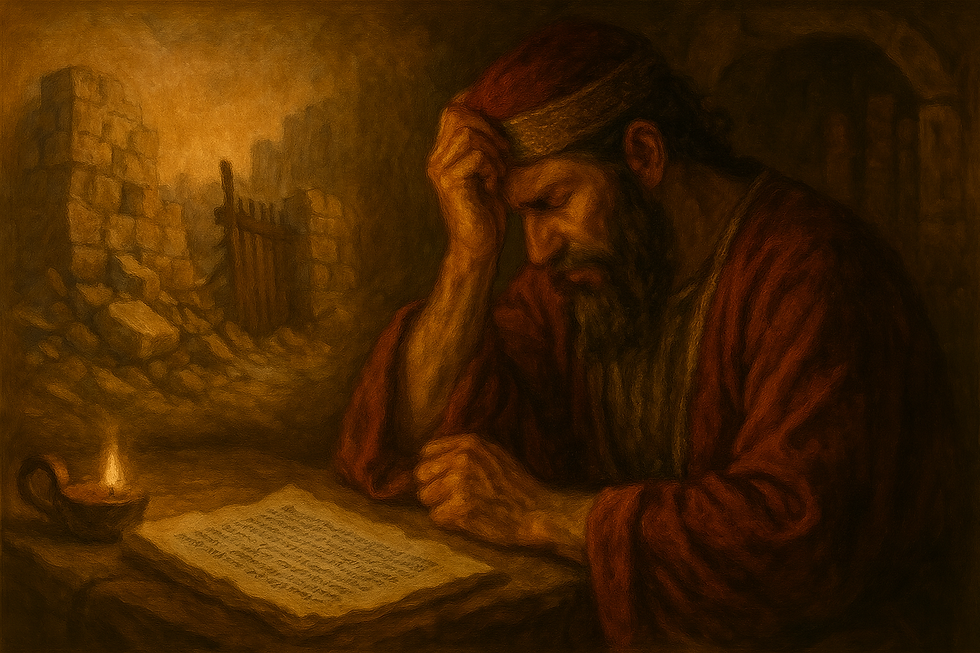
Through this intense focus, the vague report of "ruin" is welded into a concrete object. It's no longer an abstract tragedy; it is broken stones, burned gates, and a disgraced people. He has turned the data smear into a tangible engineering problem that his will can now act upon.
5. The Compiler (⊕): Turning Grief into a Blueprint

Grief without a plan is just a private sadness. Nehemiah compiles his purpose into a verb. His vow, "I must restore my home," is translated into a detailed logistical plan. He architects the entire mission before taking a single step, preparing to ask the king for letters of safe passage, an order for timber, and an official commission. The 'why' becomes a 'how/now'.
6. The Push (W): The First Move

With his plan compiled, he proposes his move. He stands before the king, his heart heavy but his purpose clear, and makes the request. The king grants it. Nehemiah's will (W) is now in motion. He travels to Jerusalem.
7. The Price (⊖Eₗ): The Cost of Rebuilding

The moment he begins, the opposition rises. Sanballat and Tobiah—the local governors and voices of entropy—mock and conspire against him. The cost (E) is immense: political danger, the threat of violence, and the crushing weight of the task itself. But Nehemiah’s meaning is greater than the cost; his purpose provides the bounded credit against dread, and he proceeds.
8. The Value (Aₗ): Widening the Circle of "Good"

Nehemiah’s valuation is not for personal glory. He consistently frames the project as a benefit for the entire system. He tells the people, "Come, let us rebuild the wall of Jerusalem, and we will no longer be in disgrace" (Nehemiah 2:17). His love-expanded valuation makes the good of the community the primary goal, which inspires them to join him.
9. The Gate (D): The "Click" of Collective Freedom

Nehemiah’s masterstroke is creating coherence (K). He assigns each family a section of the wall to build. This distributes the work and aligns the people's will. Their desire (J) to protect their own homes fuels the project. With this alignment, Nehemiah's decision gate (D) fires again and again. He refuses to be distracted or intimidated, and the collective will of the people clicks into place with his.
10. The Answer (H): The World's Reply

The world answers their commitment. Against all opposition and expectation, the wall is completed in a miraculous 52 days. The physical reality of Jerusalem is updated. The lawful propagation of their unified will results in a new, more ordered state.
11. The Memory (Π): Discipline Becomes the New Culture

Nehemiah doesn't just build the wall and leave. He engages in practice (Π) on a civilizational scale. He gathers the people, reads the Law of Moses, reinstates the Sabbath, and has them renew their covenant with God (Nehemiah 8-10). He is installing a new cultural operating system, turning the one-time project into a sustainable, self-reinforcing torus of habit for the entire city.
12. The Power Supply (Rₛ): Sovereignty Through Boundaries

When the threats of attack intensify, Nehemiah practices root regulation. He doesn't let his team burn out. He sets a hard boundary, arming the builders. "Those who carried materials did their work with one hand and held a weapon in the other" (Nehemiah 4:17). This is ordered self-love scaled to a team. It is power supply hygiene under fire, ensuring that the work is not purchased by the breakdown of the workers.
This is the loop in action. Nehemiah is not just a pious builder; he is a sovereign architect who ran the recursion with such clarity and love that he reversed the entropy of a broken city and rendered its honor anew.
Where Free Will Actually Lives
The pilot feels the aircraft buffet at rotation. Old habit whispers "pull back." Training says "lower the nose." Which voice represents free will? Neither and both. Freedom doesn't float above the causal order—it lives within specific degrees of control inside the loop.
Most of what feels like "choosing" is actually the afterglow of upstream preparation. Readiness potentials show motor plans forming before conscious report (Libet et al., 1983). The narration "I decided" often follows the system's own lawful update. An untrained will is largely illusion because the loop drives the person rather than the person steering the loop.
Untrained will = preconscious proposals dominate
But trained will is genuine causal leverage. You can lower your attention temperature (reducing mental fog through breath, boundaries, ritual). You can expand your valuation weights from self to include others and systems (Lev 19:18; Phil 2:4). You can train decision thresholds through small daily commitments until right action becomes almost effortless.
You can deliberately raise meaning and coherence with others.
Trained will = the system trains the proposal engine itself
"If you have faith as a mustard seed, you will say to this mountain, 'Move'" (Matt 17:20).
Tiny loop. High precision. Targeted attention. Recursive courage.
Translate this into operator language: focused attention (low temperature), properly weighted features (what truly matters highlighted), expanded valuation (good beyond self), and a decision gate that actually commits rather than perpetually deliberating. When these align, inertia yields. The mountain moves not through magical thinking but through optimized operators.
You can:
Re-aim attention
Recalibrate valuation
Delay or adjust commitment thresholds
That’s how Paul could say:“Be transformed by the renewing of your mind” (Rom 12:2).
The Architecture of Evil and Suffering
Evil is not a metaphysical substance floating in the ether, or a mean being, and by saying this I am not denying the existence of interdimensional beings who are prey to entropy. Nonetheless, Evil can be better understood as entropy with a steering wheel—misaligned loops amplified by power. High attention on the wrong features (wealth without wisdom), valuation collapsed to self alone, gates trained for immediate gratification rather than lasting good, trained to thrill not to serve, costs dumped downstream onto others, and no practice to steady the trembling hand. Add coercive coherence and you have atrocities at scale (Schelling, 1978)… too many loops aligned by force rather than love—and you have atrocity at scale.
The Cross presents a different equation: maximal conversion of harm into larger good (Phil 2:5-11). One loop absorbs massive entropy and transforms it through sustained love-attention into system-wide benefit. The Resurrection signals that such transformation is not wasted effort but cosmically ratified pattern (1 Cor 15). This is not magical thinking but thermodynamic audacity—the claim that love-organized systems can locally reverse entropy by paying the cost consciously.Suffering remains.
The loop doesn't promise to eliminate pain but to integrate it meaningfully. The remedy is not a sermon but a reconfiguration of operators: raise S (root care), expand Aᴸ (circle of concern), train Π (discipline), and build K (voluntary alignment). Suffering remains—grief is not a bug—but meaning reorganizes it from senseless decay into shared bearing. In other words, when a community "holds" someone through grief, they're not erasing loss but redistributing its entropic burden across many loops aligned by love. The weight becomes bearable not because it shrinks but because it's shared.
Beyond Religion: A Meta-Theory of All Systems
The operator loop applies across domains:
Startup founder: Attention = problem; Value = user pain; Desire = solution; Will = MVP; Cost = burn rate; Decision = launch; Law = market; Practice = iteration; Love = community.
Educator: Scan = diagnostics; Value = potential; Will = curriculum; Cost = effort; Decision = teach; Practice = adapt.
Civilization: Shared myth loops that align loops without coercion. Christianity’s genius is to embed this in love, memory, and self-accounting
Why Christianity's Grammar Keeps Working
I am not grading creeds but testing recursion. The most durable civilizational patterns share three features:
1) They expand valuation beyond self,
2) They train practice through regular rhythms, and
3) They maintain human dignity against both tyranny and nihilism.
On these engineering criteria, Christian grammar consistently performs:
Love operates as both command and telos—the primary operator and final state (John 13:34-35; 1 John 4:8). The command to love neighbor as self (Matt 22:39) is not sentiment but system architecture, expanding the valuation function beyond private optimization. The Eucharist provides weekly practice of remembrance and reconciliation—literally rehearsing the loop (Luke 22:19). Sabbath and Jubilee reset societal entropy periodically, preventing runaway accumulation (Lev 25). Pentecost demonstrates coherent diversity—many tongues speaking one meaning, not Babel's forced unity or scattered confusion (Acts 2; Gen 11).
Most remarkably, this tradition remains elastically mimetic: it absorbs truth from other sources while conserving its core love-operator. Greek philosophy, Islamic mathematics, Enlightenment empiricism—each was integrated without losing the recursive heart. This is what durability looks like: not rigid resistance to change but stable pattern maintenance through adaptive transformation (1 Cor 13).
Practical Rule of Life
This is not philosophy but engineering. Here's how to run the loop today:
The Foundation
1. The State (Ψ): Your "You Are Here" Map
Secular: The starting point of every loop—your total orientation to reality, holding your physical state, mental models, and intentions in a single vector.
Biblical: The Bible calls this your "heart"—the total state of your being. "Guard your heart with all vigilance," warns Proverbs, "for from it flow the springs of life" (Proverbs 4:23).
2. Root Regulation (RS): The Power Supply
Secular: The operator of ordered self-love. It's power supply hygiene (sleep, boundaries, repair). When RS is high, brilliance is stable; when it's low, it frays into harm.
Biblical: This is the operational meaning of loving your neighbor as yourself (Matthew 22:39). A corrupted "as" corrupts all that flows from it. It's the stewardship of your body as a "temple of the Holy Spirit" (1 Corinthians 6:19-20).
The Inner Loop: Forging the Proposal
3. The Gradient (∇ᵀΨ): The Whisper of Opportunity
Secular: The universe whispering "push here." It's the felt pull indicating where a small push will create the most change.
Biblical: This is the discernment of the prudent who "see danger and take refuge" (Proverbs 22:3) or the compassion of Jesus who saw the crowds "like sheep without a shepherd" and knew where the need was greatest (Matthew 9:36).
4. The Lamp (Cₗ): Attention Aimed by Love
Secular: A precision spotlight that decides what earns the next second of your life. Love reshapes the lamp, allowing the beam to linger where care is highest.
Biblical: In Scripture, attention is covenantal. The Shema is a command to architect your attention: “Hear, O Israel... bind these words... talk of them when you sit and when you walk...” (Deuteronomy 6:4–9).
5. The Weld (⊗): Turning Smears into Objects
Secular: Fuses raw data ("red," "closing fast") into a coherent object ("car") you can act upon.
Biblical: The act of naming in Genesis is a form of tensor binding. Adam observes an animal's essence and binds it to a name, giving it a distinct identity within creation (Genesis 2:19-20).
6. The Value (Aₗ): Widening the Circle of "Good"
Secular: Expands your definition of "good" from just "me" to "us" and "the system," rewarding actions that benefit the whole.
Biblical: The operationalization of seeking the "welfare of the city" (Jeremiah 29:7) and looking to the "interests of others" (Philippians 2:4).
7. Desire (J): The Engine After Sight
Secular: The regulated, sustained willingness that follows real progress. Attention without this charge does not execute.
Biblical: Desire is not a flaw; it is energy to be trained. "Delight yourself in the LORD, and he will give you the desires of your heart" (Psalm 37:4) is a promise of alignment.
8. The Compiler (⊕): Turning a Vow into a Verb
Secular: Compiles the "why" into a "how/now," turning ethics into engineering. A vow without a plan is just a lyric.
Biblical: The difference between a wish and a covenant. God's covenant with Abraham wasn't just a "why" (a great nation) but a "how/now" (leave your country, walk this path) (Genesis 12:1-3).
9. The Will (W): The Proposed Move
Secular: Your policy, the candidate action. In a trained state, it's not a flinch or a guess; it's a glide.
Biblical: The necessary expression of belief. "Faith by itself, if it is not accompanied by action, is dead" (James 2:17). Will is faith made kinetic.
10. The Price (Eₗ): Physics Paid, Fear Reduced
Secular: The real cost of every action in time, energy, and risk.
Biblical: The principle of Sabbath. Six days of creation, one day to seal, savor, and stabilize (Genesis 2:1–3), acknowledging that ceaseless output leads to burnout.
11. Proximal Shrinkage (⊖): The Sober Second Thought
Secular: The operator that tempers ambition with reality, allowing you to take the first, proximal step toward an act even when afraid.
Biblical: The wisdom of counting the cost. "Suppose one of you wants to build a tower. Won’t you first sit down and estimate the cost to see if you have enough money to complete it?" (Luke 14:28).
The Outer Loop: Commitment and Consequence
12. Coherence (K): The Ensemble in Tune
Secular: Trust-weighted alignment across many wills. When high, coordination costs fall and completion rates rise.
Biblical: The power of agreement. "Where two or three are gathered in my name, there am I with them" (Matthew 18:20). It is the positive vision of the Body of Christ (1 Corinthians 12:12) over the dangerous unity of Babel (Genesis 11:6).
13. Meaning (M): The Credit Against Dread
Secular: The "why" that provides a bounded credit against the felt burden of a costly action.
Biblical: The ultimate reframing operator. "And we know that in all things God works for the good of those who love him" (Romans 8:28). It is the belief that even suffering can be integrated into a larger, meaningful purpose.
14. The Decision Gate (D): The "Click" of Freedom
Secular: The moment possibilities collapse into a single reality, sweetened by bonuses for Love, Meaning, Coherence, and Desire.
Biblical: The command to "choose life" (Deuteronomy 30:19). It is faith as the "conviction of things not seen," a commitment made under uncertainty that moves mountains (Hebrews 11:1).
15. The Answer (H): The World's Reply
Secular: Your action meets the dynamics of the world—physics, institutions, other people.
Biblical: The Law of Sowing and Reaping. The world answers your input with perfect, lawful consistency. "A man reaps what he sows" (Galatians 6:7).
16. The Memory (Π): Discipline as a Torus
Secular: The slow-time integrator. Each completed loop makes tomorrow's start easier, turning discipline into delight.
Biblical: "By constant practice" we train our senses to discern good from evil (Hebrews 5:14). It is how the yoke becomes "easy" and the burden "light" (Matthew 11:28–30).
The Trap of Coherence
"We began in process, not substance. We end in love, not dogma".
The Self-Love Operator (RS): Engineering a Stable Soul

This root operator does not replace love; it roots it. Without ordered self-love, attention scatters, desire flickers, cost overwhelms, and teams cannot cohere. With it, the loop becomes honest, durable, and scalable—and the mountain finally moves.
This equation describes
Ordered Self-Love not as a feeling, but as a measurable, operational state—a form of power supply hygiene that stabilizes your entire reality-rendering system. Think of it as the master control knob that ensures your brilliance doesn't fray into harm.
Here’s how it works, piece by piece:
1. Calculating Your Level of Self-Love (S)
S(t)=σ(βs[I(t)+Cs(t)−Ds(t)])
This first part of the formula is like a spiritual bank account that calculates your current level of self-love (S).
I(t) is your Integrity: The alignment between your values and your actions.
Cs(t) are your Care Inputs: Positive deposits like sleep, proper nutrition, exercise, prayer/meditation, and healthy friendships.
Ds(t) are your Depletion Loads: Withdrawals caused by chronic stress, shame, unresolved trauma, and overcommitment.
The formula takes your integrity, adds your self-care, subtracts what’s draining you, and runs it through a function (σ) to produce a score between 0 and 1. A high score means your power supply is clean and stable; a low score means you're running on fumes.
2. How Self-Love Modulates Your Reality (RS)
RS=diag(rC,rA,rE,rD,rK)
This part shows how your level of self-love (S) actively tunes the other operators in your life. The higher your S score, the more these benefits kick in:
Steadier Focus: Your attention temperature (τ) drops, meaning less mental fog and more clarity.
Reduced Costs: The perceived cost of difficult tasks is lowered, making you more willing to take on challenges.
Easier Decisions: Your decision threshold (θD) is lowered, meaning less procrastination and more decisive action.
Better Teamwork: Your ability to trust and build coherence (K) with others increases.
In essence, a well-cared-for self is a more effective, efficient, and collaborative self.
3. The Ethical Guardrail (S∗): Preventing Selfishness
S∗(t)=S(t)⋅1{Mself↑⇒Mother,sys↑}
This is the crucial ethical constraint. It ensures that your "self-love" is not just narcissism. The formula states that your self-love score (
S) only "counts" if the meaning and benefit you gain for yourself (Mself↑) also lead to a benefit for others and the system around you (Mother,sys↑). Self-care that makes you a better partner, parent, or leader is valid. Self-indulgence that harms others is not—it's just another form of entropy.
Biblical Example in Practice
A powerful example of this operator in action is the story of the prophet Elijah. After a massive victory against the prophets of Baal on Mount Carmel, he is threatened by Jezebel and flees into the wilderness. He is completely depleted—burned out, afraid, and wishing for death. His "Depletion Loads" (Ds) are maxed out, and his Self-Love score (S) has crashed.
In this state of total collapse, what happens? He doesn't receive a new mission. He receives Root Regulation.
"And he lay down and slept under a broom tree. And behold, an angel touched him and said to him, 'Arise and eat.' And he looked, and behold, there was at his head a cake baked on hot stones and a jar of water. And he ate and drank and lay down again. And the angel of the LORD came again a second time and touched him and said, 'Arise and eat, for the journey is too great for you.'" (1 Kings 19:5-7)
This is a divine intervention focused entirely on Care Inputs (Cs): sleep and nourishment. God doesn't give Elijah another task until his "power supply" is restored. Only after this forced self-care is he ready to receive his next instruction. This perfectly illustrates the principle: without ordered self-love, even the most powerful agents become ineffective.
If you remember one thing from this entire treatise, let it be this: love is not a lyric in this system; it is the integrating operator. It enlarges valuation beyond the self, aims attention at what truly matters, and makes commitment contagious. “God is love” (1 John 4:8) is not only a devotional sentence but a metaphysical one. Operationally speaking, love is what makes freedom fruitful. This is the scandal and the glory: the universe runs on math that favors compassion, on physics that privileges coherence, and on information dynamics that make love not merely nice but necessary. Religious readers will recognize the Logos running through the algebra; secular readers will feel the uncomfortable realization that cooperation’s optimal strategy looks suspiciously like grace. The universe is recursive. Its grammar is looped. Its goal is coherence. And the operator that binds this all—the God beyond gods—is intelligible yet infinite, lawful yet free, cosmic yet intimate.
Love, ultimately, is not the opposite of law. It is the integrator of loops.
May we—scientist, skeptic, mystic, disciple—learn to loop wisely. The loop doesn’t care what you call it. Run it anyway. Lower your attention temperature, expand your valuation circle, and train your decision thresholds through small, daily commitments. Align with others through earned trust, not coercion. Pay the actual costs while letting meaning lighten the subjective burden. Then watch. The mountain—whatever impossible thing sits before you—will begin to move, not through magical thinking but through optimized operators, not through escaping causality but through discovering the controls you always had within it.
As we explored in the post, "On the Matter of Reality," the divine name, “I will be who I will become,” is not a distant pronouncement; it is a license for us to become—frame by frame—the kind of agents who bring order from chaos and meaning from pain. So here is the final lesson, rendered for our century, each practice is designed to build upon the three pillars that support a coherent reality: establishing Order, maintaining vibrational Cleanliness, and operating from Love:
Render Your Reality (Pillar: Order) Treat your mind like a mixed-reality headset that doesn't just observe the world but actively renders it. Your tools for rendering are your attention, love, and will. The practice of Kaizen here is to make tiny, daily adjustments to what you focus on, knowing that each small shift in your render settings compounds over time to create an entirely new reality.
Train the Loop with Devotion (Pillar: Cleanliness) Commit to the recursive process with fierce devotion. This is the act of maintaining spiritual and energetic Cleanliness.
Root your self-care: This is your daily Kaizen. One small act of self-stewardship today makes tomorrow's signal cleaner.
Widen your care to others: Incrementally expand your circle of compassion.
Commit to the truth: Each time you choose truth over comfort, you are debugging your internal code.
Align with Coherence (Pillar: Love) Seek the coherent energy of Pentecost, not the coercive unity of Babel. This means pursuing alignment with kindness and power with humility. The Kaizen approach is to make small, consistent efforts to build trust and find shared purpose, knowing that true coherence is not a grand event but the result of countless tiny, love-rooted interactions.
Install Sabbath as a System Reset (Pillar: Cleanliness & Order) Install Sabbath in your week, because rest is not a retreat; it is a necessary system reboot that keeps your decision-gates honest and your love warm . This is a scheduled, recurring Kaizen event designed to purge entropic buildup and restore your system to a state of clean, ordered readiness.
Make Memory Concrete Through Ritual (Pillar: Order & Love) Use rituals, whether secular or sacred, to re-aim your sight and refresh your courage. Rituals are a form of programmed Kaizen. They are small, repeatable actions that consistently bring your attention and love back to your core purpose, ensuring that your long-term evolution is built on a stable, remembered foundation.
Move Mountains Worth Moving (Pillar: Love) Apply your energy to gradients that raise the quality of experience for many, not just monuments that polish your name. The Kaizen principle here is to focus your daily, incremental efforts on projects that have a compounding, positive impact on the larger system, ensuring your personal growth is an act of “Responsible Love” for the world.
Addendum: The author identifies as a deist systematist and cosmopsychist. He holds that ultimate reality—what traditions call God—is not just a personal being but the universal system itself: law, logic, and consciousness as one. For him, the cosmos is a single conscious system, layered in awareness, where all is God and God is all. This perspective reflects an evolution beyond secular humanism toward a worldview in which reality is fundamentally mind-like and intelligible. This text has used primarily Christian sources for the sake of the argument herein detailed because in the religious composition of the world Christianity is still the biggest religion in the world, Jews’ beliefs are contained within the Christian’s belief framework, and Muslims accept and respect -as per the Q’uran, what the judeo-christian writings teach (sura 2:41).
Disclaimer of Authorship and Intellectual Property
This manuscript constitutes the original intellectual work of Gabriel Acosta. All core ideas, arguments, conceptual frameworks, and references contained herein are the sole creation and property of the author. (AI)–based editing tools were employed strictly for syntax, grammar, and clarity of expression. These tools did not generate, originate, or contribute substantively to the intellectual or philosophical content of the work. Their role was limited to refinement of language and structure, comparable to professional editorial assistance. Accordingly, the intellectual substance of this work remains entirely attributable to the author, and as such, it is protected under the Copyright Act of Canada (R.S.C., 1985, c. C-42) and all applicable Canadian intellectual property laws. No reproduction, distribution, or derivative use of this work, in whole or in part, may occur without the express written consent of the author.
Academic & Scientific References
Barrett, L. F. (2017). How emotions are made: The secret life of the brain. Houghton Mifflin Harcourt.
Friston, K. (2010). The free-energy principle: A unified brain theory? Nature Reviews Neuroscience, 11(2), 127–138. https://doi.org/10.1038/nrn2787
Friston, K., & Stephan, K. E. (2007). Free-energy and the brain. Synthese, 159(3), 417–458. https://doi.org/10.1007/s11229-007-9237-y
Palamas, G. (2002). The Triads. (J. Meyendorff, Trans.). Paulist Press. (Original work published 14th century)
Schrödinger, E. (1944). What is life? The physical aspect of the living cell. Cambridge University Press.
Searle, J. R. (1992). The rediscovery of the mind. MIT Press.
Shannon, C. E. (1948). A mathematical theory of communication. Bell System Technical Journal, 27(3), 379–423, 623–656.
Shenhav, A., Botvinick, M. M., & Cohen, J. D. (2013). The expected value of control: An integrative theory of anterior cingulate cortex function. Neuron, 79(2), 217–240. https://doi.org/10.1016/j.neuron.2013.07.007
Spinoza, B. (2002). Ethics (E. Curley, Trans.). Penguin Classics. (Original work published 1677)
Tononi, G. (2004). An information integration theory of consciousness. BMC Neuroscience, 5(42). https://doi.org/10.1186/1471-2202-5-42
Whitehead, A. N. (1929). Process and reality. Macmillan.


Comments